
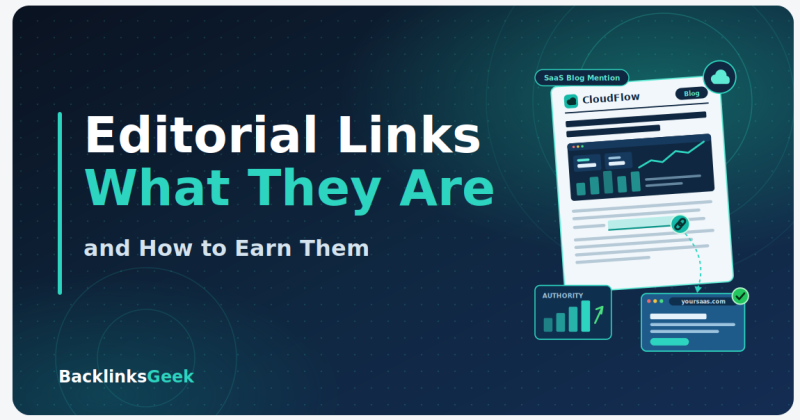
We all know that there are multiple types of backlinks. One of the most valuable types is editorial links. These are naturally earned when other websites and publications cite your content as a reliable source.
Unlike other backlinks, editorial links are usually earned when other publishers independently cite your content on the basis of its relevance, accuracy, and quality. These links act as a vote of confidence, potentially improving SERP visibility and attracting referral traffic.
In today’s guide, we will be taking a close look at what editorial backlinks are while also learning how you can earn them. So, hang around till the end; it will be worth reading!
What are Editorial Backlinks?
As mentioned earlier, editorial backlinks are links that publications naturally include in their content to reference another website or source. These links are typically earned when third-party publishers find your website’s content:
- Relevant
- Updated
- Credible
- Informative
For these reasons, they may cite your website within their content as a reliable source of information for their target audience.
For example, if you have performed comprehensive research on “how many marketers are using AI or planning to adopt it,” then a marketing blog may link to that research. This link would be considered an “editorial backlink.”
Comparison Table of Editorial Links with Other Backlink Types
In the following table, we have compared editorial backlinks with other types of links, so that you can have a better understanding.
Backlink Type | How It Is Acquired | Publisher Control | Key Characteristic |
| Editorial Links | Earned naturally when publishers reference valuable content | High | Given based on content quality, relevance, or credibility |
| Guest Post Links | Obtained by contributing an article to another website | Shared | Included within contributed content, subject to publisher guidelines |
| Niche Edit Links | Added to existing published content | Depends on the arrangement | Placed within a relevant, previously published article |
| Directory Links | Obtained by submitting a website to an online directory | Directory-controlled | Listed in relevant business or industry categories |
Alert: You should keep in mind that the SEO value of backlinks heavily depends on their topical authority, contextual relevance, and content quality. This means getting an editorial backlink does not automatically mean it will be valuable in every situation.
How You Can Earn Editorial Backlinks
Below, we have discussed some key strategies for earning editorial backlinks.
Create Top-tier Content
Creating high-quality content is one of the key ways to earn editorial links. When you publish unique, accurate, and valuable content, other publishers may consider and reference your site in their content as a reliable source.
Example:
A SaaS company creates a comprehensive blog post explaining how businesses can improve customer retention. It covers practical strategies, relevant examples, and reliable data to answer audience questions. As a result, other marketing blogs may naturally link to it when discussing anything about customer retention.
The good thing is that you can create different types of content, including:
- Comprehensive guides
- How-to articles
- Industry reports
- Expert roundups
- Free tools and resources
Whatever content format you go with, just remember that the content should be useful, original, and accurate.
Get in Touch with Journalists and Publishers
This is yet another way to earn high-quality editorial backlinks. Journalists and publishers regularly look for reliable sources, expert opinions, and unique information to support their content.
Here, your content quality will play a pivotal role. If they find your content credible and authoritative, they may link to it in their research material, resulting in an editorial link.
Now, you may be thinking about how to build relationships. Well, here is the practical approach:
- Identify relevant publishers: Look for journalists and publishers who operate in your target niche or industry. To find them, you can use social media platforms, especially LinkedIn and X (formerly Twitter). Besides this, you can also visit publication websites and their author pages.
- Understand their work: Read their articles and other content to determine their interests and the type of sources they typically use.
- Engage with professionals: Participate in discussions while keeping their work preferences in mind. Avoid making every interaction a sales pitch. Instead, focus on providing real value.
Example: Let’s say a journalist is writing about emerging trends in marketing; as a marketing professional, you can contribute by offering valuable insights. If they find your contribution helpful, they are more likely to reference it, resulting in an editorial backlink.
Value-driven Manual Outreach
This method involves finding websites covering articles that lack key data, information, or context and then pitching your resource as a natural addition that improves their content.
Unlike generic outreach emails that solely focus on requesting relevant backlinks, this approach focuses on giving the publisher a clear reason to reference your web content in their existing article to improve its quality.
Example:
If you have a well-researched blog on “Marketing trends,” then you can find and reach out to relevant bloggers who cover similar topics. Clearly explain to them how your information can support their content and engage the target audience.
Here are a few tips and tricks to make your outreach more effective:
- Only reach out to relevant websites: Only reach out to websites and bloggers whose content aligns with your industry, expertise, and target audience.
- Personalize your message: In your outreach message, give proper reasoning to convince them that adding your website’s reference will be beneficial for their content.
- Follow up professionally: In case you don’t receive any response, reach out again with a polite yet professional follow-up message.
Finding Unlinked Brand Mentions
Finally, finding unlinked brand mentions is another effective way to earn editorial backlinks. Oftentimes, websites mention your website, product, or specific service within their content without giving a link to you. This is referred to as an unlinked brand mention.
Your job is simple – find the unlinked brand mentions and then politely ask the editor whether they are fine with adding a hyperlink to your website to help access further information.
Now, the real question is: how exactly can you find unlinked brand mentions? Well, you can use specialized brand mentioning tools that are easily available online. Many are free, simple, and secure to use.
After finding an unlinked mention, here is what you need to do:
- Check for context: Make sure your brand mention is accurate and fits naturally within the covered topic. Also, ensure the website on which it is mentioned is credible and legitimate.
- Contact the publisher: Contact the editor of the website and request that they add a hyperlink to your website where the brand appears.
Final Words
Editorial links are one of the most valuable types of backlinks that are earned naturally when other sites reference your content as a reliable source. That’s why these links may pass more SEO value and help enhance overall SERP visibility. You can earn editorial links in several ways, such as creating high-quality content, building relationships with journalists, value-driven manual outreach, and finding unlinked brand mentions. This blog post has covered all these effective ways in complete detail.
Comments